Type a query in LLMs (ChatGPT, Perplexity, or Google’s AI Mode), and you won’t get blue links, but a precise, curated answer.
Although there will be a handful of websites that get mentions by their names, and hundreds of websites won’t get a place. The difference between the two groups is no longer just about their rankings, but about the content.
Like whether their content was built to be understood, trusted, and quoted by a machine that reads the whole internet before it writes a single sentence. That’s why Generative Engine Optimization (GEO) exists to solve.
As an SEO specialist, I’ll put everything on the table about GEO: where it came from, what its future is, and how you can benefit your business by optimizing for GEO.
What is Generative Engine Optimization (GEO)?
Generative Engine Optimization is the practice of structuring content, brand presence, and digital assets so that AI systems can reference, cite, or recommend them when generating answers to user questions.
Where traditional SEO competes for a spot on a results page, GEO competes for a spot inside the answer itself.
You’re no longer writing for a ranking algorithm that hands the user a list. You’re writing for a language model that reads dozens of sources, decides which facts matter, and folds a handful of them into a single generated response.
Some industries call this AEO (answer engine optimization) or AIO (AI optimization). However, the underlying goal is the same: be part of what the AI says, not just part of what it could have linked to.
Where the GEO Term Came From in the SEO Industry
Generative Engine Optimization (GEO) isn’t a marketing buzzword that emerged from an agency blog. It has an academic origin.
“In late 2023, a team from Princeton University, Georgia Tech, IIT Delhi, and the Allen Institute for AI published a paper simply titled “GEO: Generative Engine Optimization,” presented at the 30th ACM SIGKDD Conference in 2024.”
The researchers built GEO-bench, a benchmark of roughly 10,000 real user queries paired with the web sources a generative engine would actually pull from to answer them.
They then tested nine different content modification strategies against that benchmark, using a system designed to mimic how AI answer engines retrieve and synthesize information, and validated the strongest results on Perplexity as a real-world check.
The paper found that certain content changes could lift a source’s visibility inside generated answers by up to 40 percent, while other classic SEO tactics, like keyword stuffing, actually performed worse than doing nothing at all.
That single study effectively created the field of GEO. Everything written about GEO since, including most agency playbooks, traces back to it in some way.
SEO vs. GEO vs. AEO: What Actually Separates Them
SEO, GEO, and AEO or AIO get used almost interchangeably, but they describe different jobs in reality. However, every term is based on traditional SEO basics, like if a website’s SEO performance is good, then it can continue to be mentioned in AI systems.
“At Bluelinks Agency, we firmly believe that GEO & AEO is nothing but good SEO.”
GEO and AEO rely entirely on the core technical and authoritative foundations of traditional SEO. Good SEO ensures a site is crawlable, structured, and trusted, which naturally allows AI engines to read, parse, and cite the content.
But if we categorize these terms in sections or steps or characteristics, then:
- SEO aims to rank a page in a list of search results. Success is measured in rankings, clicks, and sessions, and the attribution path is clean: someone searched, clicked, and landed on your page.
- GEO aims to get a brand, product, or claim mentioned inside an AI-generated answer, whether or not the user ever clicks through. Success is measured in citation frequency, share of voice, and how favorably a brand is framed, not in traffic alone.
- AEO or AIO sits closer to GEO and is sometimes used as a synonym, but it originally described optimizing for direct-answer boxes and voice assistants before generative AI matured. In practice, most teams now treat AEO and GEO as the same discipline with different names.
The three disciplines share a foundation. A page that isn’t crawlable, isn’t indexed, or is technically broken won’t get pulled into an AI-generated answer any more than it would rank on Google.
That’s why most serious GEO practitioners describe it as sitting on top of SEO, and not replacing it. Strong technical SEO and topical authority remain the entry ticket. GEO is what determines whether you’re one of the sources the model actually chooses to quote once it’s found you.
Why GEO Matters The Most in 2026
The behavioral shift behind GEO is already measurable.
Industry tracking through 2026 shows a consistent pattern across sites: search impressions climbing while click-through rates fall, because AI-generated summaries increasingly answer the question directly on the results page instead of sending the user further.
For any business that depends on informational content to build an audience or a sales pipeline, that’s a structural change in how visibility converts into revenue, and not a temporary dip.
At the same time, GEO remains a young discipline compared to SEO’s two decades of established practice. That gap works two ways. Measurement is harder because AI platforms don’t reliably pass referral data the way search engines do, so tying an AI mention back to a signup or a sale takes real analytical work.
However, the content gap in most categories is still wide, meaning brands that build GEO-ready content now are claiming positions competitors haven’t contested yet.
How Generative Engines Actually Decide What to Cite
Most generative engines, whether it’s ChatGPT with browsing, Perplexity, or Google’s AI Overviews, run some version of a two-stage pipeline.
- First, a retrieval stage pulls a shortlist of candidate sources from the internet, often the same top results a traditional search engine would surface.
- Second, a generation stage synthesizes those sources into a single written answer, deciding which facts to include, how to phrase them, and which sources earn a visible citation.
This matters because doing well at stage one doesn’t guarantee doing well at stage two. A page can rank on the first page of Google and still get skipped over when the model writes its answer, because ranking and being quotable are different skills.
Later academic work building on the original Princeton study has looked specifically at this gap, arguing that content needs to be optimized for both stages jointly rather than treating retrieval and citation as the same problem.
How to Optimize for Core GEO Strategies in 2026
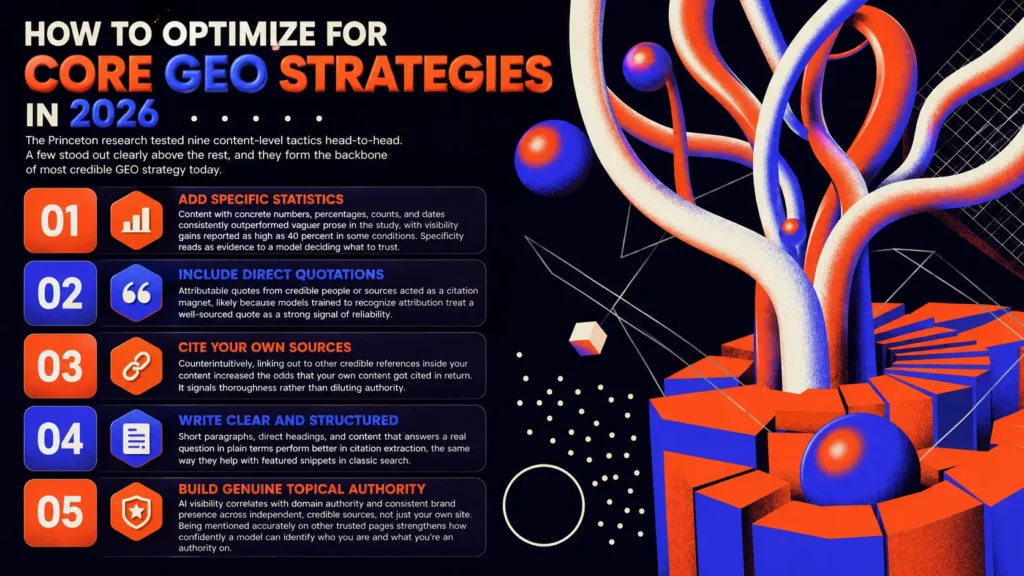
The Princeton research tested nine content-level tactics head-to-head. A few stood out clearly above the rest, and they form the backbone of most credible GEO strategy today.
1. Add Specific Statistics
Content with concrete numbers, percentages, counts, and dates consistently outperformed vaguer prose in the study, with visibility gains reported as high as 40 percent in some conditions. Specificity reads as evidence to a model deciding what to trust.
2. Include Direct Quotations
Attributable quotes from credible people or sources acted as a citation magnet, likely because models trained to recognize attribution treat a well-sourced quote as a strong signal of reliability.
3. Cite Your Own Sources
Counterintuitively, linking out to other credible references inside your content increased the odds that your own content got cited in return. It signals thoroughness rather than diluting authority.
4. Write Clear and Structured
Short paragraphs, direct headings, and content that answers a real question in plain terms perform better in citation extraction, the same way they help with featured snippets in classic search.
5. Build Genuine Topical Authority
AI visibility correlates with domain authority and consistent brand presence across independent, credible sources, not just your own site. Being mentioned accurately on other trusted pages strengthens how confidently a model can identify who you are and what you’re an authority on.
Tactics that leaned on old SEO habits, like repeating keywords or stuffing in unnatural phrasing, performed worse than untouched baseline content in the same study. Generative engines are not rewarding the same signals search engines rewarded 15 years ago.
How to Measure Whether GEO is Working or Not
This is the part most teams get wrong first, because the old scoreboard doesn’t translate directly.
Start by manually testing your brand against the questions your buyers would actually ask. Run your top category prompts through ChatGPT, Perplexity, and Google AI Mode repeatedly, ideally monthly, and document what comes back: are you mentioned, how are you framed, and who’s mentioned instead of you.
From there, track a small set of AI-specific indicators alongside your normal analytics:
- How often your brand is mentioned across generated answers, whether that mention links back to your site or just names you
- How you’re framed relative to competitors
- Any shift in direct or “dark social” traffic that might reflect someone who saw your name in an AI answer and came looking for you later without a trackable click.
None of this replaces your existing SEO dashboard. It sits next to it, because the two channels are measuring different parts of the same buyer journey.
Common GEO Misconceptions Needed to Be Busted
“GEO replaces SEO.” It doesn’t. Crawlability, site structure, and backlink quality still determine whether your content is discoverable at all before a model ever gets the chance to cite it.
“Keyword optimization still works the same way.” It doesn’t transfer cleanly. The research is fairly direct on this: tactics built around keyword density underperformed compared to doing nothing, while specificity and sourcing outperformed it.
“If you’re not being clicked, you’re not getting value.” AI mentions can build awareness and trust without a click ever being logged, which is exactly why GEO needs its own measurement approach instead of being judged by SEO’s yardstick.
“This is a fad that will pass.” The underlying behavior shift (more impressions, fewer clicks, more direct answers) has held steady across industry tracking through 2026 rather than reversing.
Where GEO is Headed in the Future
Similar to SEO, GEO is always going to develop, update, and grow in different shapes throughout the years. Although measurements will standardize as more tools build reliable ways to track brand presence across generative engines.
The difference between SEO and GEO will keep blurring as brands desperately want to be a part of AI-generated answers. And as AI-driven recommendations start meaningfully influencing consumer decisions, expect more scrutiny over how these systems choose and disclose their sources.
For now, the practical takeaway is simple. The brands treating GEO as an extension of good content practice, not a trick to game a new algorithm, are the ones building a durable advantage while the category is still wide open.
People Also Ask
Q1. Is GEO the same thing as AEO?
They’re closely related and often used interchangeably. AEO originally referred to optimizing for direct-answer boxes and voice search, while GEO specifically targets visibility inside AI-generated responses.
Q2. Do I need to abandon my SEO strategy to do GEO?
Absolutely not. Strong technical SEO, crawlable pages, clean site structure, and topical authority remain the foundation that lets AI systems find and trust your content in the first place.
Q3. Can I track exactly how much traffic GEO is generating?
Not with the same precision as SEO. AI platforms don’t consistently pass referral data, so a portion of GEO’s value shows up as brand mentions, sentiment, and later direct traffic rather than a clean, trackable click.
Q4. Does GEO work differently across industries?
Yes, of course. The original research specifically found that the effectiveness of GEO strategies varies by domain, which means a tactic that lifts visibility strongly in one industry may perform quite differently in another.