Imagine this.
You run a business for five years. You build a strong team. You deliver great work. You earn loyal customers. Then one morning, a competitor posts three fake one-star reviews on your Google profile overnight. Your rating drops from 4.8 to 3.9. Your phone slows down. Your bookings dry up. And the worst part you don’t even know it’s happening until the damage is done.
This is not a rare story. It happens to businesses, doctors, lawyers, and executives every single day.
And most of them have no idea they can fight back or better yet, prevent it entirely.
That is what online reputation management is for.
In this guide, we break down everything you need to know about ORM what it is, how it works, who needs it, and how to start today.
What Is Online Reputation Management (ORM)?
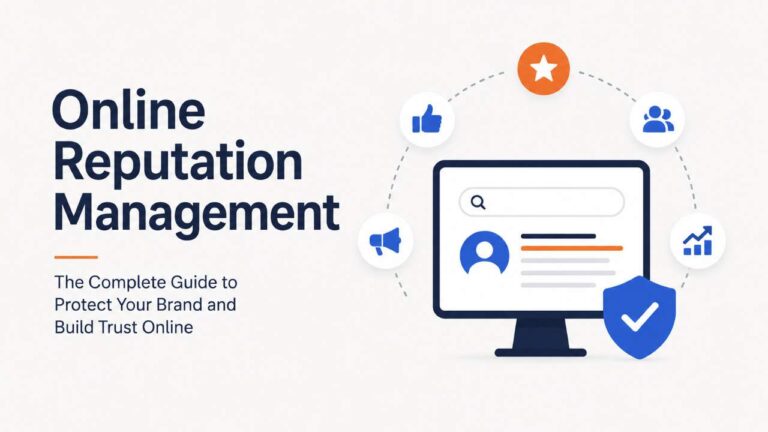
Online reputation management (ORM) is the practice of controlling what people find when they search for your name or business online.
When someone Googles your name, your business name, or your brand, Google shows them a list of results. Those results might include your website, your social media profiles, news articles, customer reviews, forum discussions, and blog posts. Some of those results are positive. Some might be negative. And some might be completely wrong.
ORM is the process of making sure those results show the best and most accurate version of you.
Think of it like this. Your online reputation is a public billboard on the busiest street in the world. Millions of people drive past it every day potential customers, employers, investors, and partners. ORM makes sure that billboard says exactly what you want it to say.
At Bluelinks Agency, we define ORM simply: it is the ongoing process of making sure the internet tells your story the right way.
ORM uses a combination of search engine optimization (SEO), content marketing, public relations (PR), review management, and social media strategy to shape what appears in search results.
Why Does Your Online Reputation Matter More Than Ever?
Here is a fact that should stop every business owner in their tracks.
According to BrightLocal’s 2024 Local Consumer Review Survey↗, 98% of consumers read online reviews before buying from a local business. And 57% of people say they will not use a business with fewer than four stars on Google.
That means your Google rating is now your most powerful sales tool more powerful than your website, your brochure, and your sales team combined.
The stakes are even higher for individuals. Doctors lose patients because of one unfair review. Lawyers lose clients because a disgruntled former employee left a damaging comment on Reddit. Executives lose board positions because a journalist wrote a critical piece five years ago that still ranks on page one.
A Harvard Business School study found that a one-star increase in a business’s Yelp rating leads to a 5 to 9 percent increase in revenue. One star. That is the power your online reputation holds over your income.
Here is what a damaged online reputation actually costs people and businesses:
Job candidates lose job offers because hiring managers search their name and find something uncomfortable. Businesses lose sales because negative reviews appear above their own website in search results. Startups lose funding because investors Google the founders and find old controversies. Healthcare professionals lose patients before those patients even pick up the phone.
ORM gives you the power to take control of this. It does not erase the past. But it shapes what the future looks like online.
How Does Online Reputation Management Work?
ORM works through four core strategies. These strategies work together to promote positive content and push negative content down in search results ideally off the first page of Google entirely.
Step One: Monitor
You cannot manage what you do not measure.
The first stage of ORM is knowing exactly what people are saying about you, where they are saying it, and how far it is spreading. ORM professionals set up monitoring tools that scan Google, social media platforms, review sites, forums, and news sources. These tools send real-time alerts whenever someone mentions your name or brand online.
Monitoring means you are never caught off guard. You find out about a problem within hours not weeks.
Step Two: Suppress
When negative content appears on the first page of Google, the primary goal is to suppress it to push it off the first page entirely.
Google shows ten results per page. Most people never search past the first page. So if a negative article sits at position seven, it reaches thousands of people every month. If you push it to page two, most of those people never see it.
You suppress negative content by creating better, stronger, more authoritative positive content that outranks it. Blog posts, press releases, social media profiles, directory listings each one becomes a new result that competes for the same space.
Step Three: Promote
Suppression and promotion work hand in hand.
ORM professionals actively build and promote positive content client case studies, media coverage, expert articles, strong social profiles, and glowing testimonials. This content makes it harder for any negative content to compete, and it reinforces a trustworthy, credible image every time someone searches your name.
Think of it like a garden. You do not just pull weeds. You also plant healthy, strong plants that crowd out the weeds over time and eventually take over the garden completely.
Step Four: Respond
Some reputation problems require a direct response.
Negative reviews, public complaints, or media stories sometimes need you to step in and say something. A professional ORM strategy includes a clear response plan how to reply to negative reviews, when to issue a statement, and how to handle a public relations crisis without making it worse.
Responding the right way shows potential customers that you take feedback seriously. A well-crafted response to a negative review can actually turn a skeptical reader into a customer.
What Are the Types of Online Reputation Management?
ORM is not one-size-fits-all. Different people and businesses need different approaches.
Personal ORM
Personal ORM focuses on what appears when someone searches your full name. This matters most for executives, doctors, lawyers, politicians, influencers, job seekers, and anyone whose personal reputation directly affects their career or income.
Personal ORM involves building a Google Knowledge Panel, managing social profiles, publishing authoritative content under your name, and suppressing any negative articles or reviews linked to you as an individual.
Business ORM
Business ORM focuses on what customers, partners, and investors find when they search for your company. This includes managing Google reviews, Trustpilot ratings, news coverage, and search results for your brand name and product names.
Proactive ORM
Proactive ORM means building your reputation before anything goes wrong. It creates a strong foundation of positive content so that even if a negative piece appears, it cannot easily reach the first page of Google.
This is the smartest and most cost-effective form of ORM. Prevention always costs less than damage control.
Reactive ORM
Reactive ORM is damage control. It kicks in after a reputation problem has already happened a crisis, a negative article, a flood of bad reviews, or a social media controversy.
Reactive ORM takes longer and costs more than proactive ORM. But it works. At Bluelinks Agency, we have helped businesses recover from serious reputation crises, including removing negative press from Google’s first page within 60 to 90 days in many cases.
What Does an ORM Campaign Actually Include?
Let’s get specific. A professional ORM campaign uses these tactics and often several at once.
Review Management: An ORM team responds to every Google, Yelp, Trustpilot, and industry-specific review. They guide satisfied customers to leave positive reviews. They report fake or policy-violating reviews to platforms for removal. They track rating trends and identify patterns in feedback.
Google Knowledge Panel Creation: A Google Knowledge Panel is the information box that appears on the right side of search results for recognized people and businesses. It shows your name, photo, description, social links, and key facts. It signals authority and takes up prime search real estate. Building one correctly requires structured data, entity authority, and coordinated digital PR.
Content Creation and Publishing: ORM professionals write expert articles, blog posts, case studies, and press releases that rank in search results and provide positive content to outrank negative pages.
Link Building: High-quality backlinks from authoritative websites help positive content rank above competing negative pages. ORM campaigns build these links through digital PR, partnerships, and outreach.
Social Media Profile Optimization: LinkedIn, Facebook, Instagram, Twitter/X, and YouTube profiles appear prominently in Google searches for your name. ORM ensures these profiles are complete, accurate, and professionally presented.
Press Release Distribution: Press releases distributed through wire services get picked up by news outlets and create high-authority pages that rank strongly for brand name searches.
Wikipedia and Wikidata Management: For high-profile individuals and established businesses, Wikipedia and Wikidata profiles carry enormous authority in Google’s eyes. Correct management of these profiles is a significant part of personal ORM.
Third-Party Directory Listings: Profiles on Crunchbase, Clutch, Bloomberg, and other authoritative directories each create another positive, high-authority result that Google surfaces for brand searches.
ORM vs SEO vs PR — What Is the Difference?
Many people confuse these three disciplines. They overlap but they are not the same.
SEO (Search Engine Optimization) focuses on improving a website’s rankings for specific keywords so more people visit the site. SEO drives traffic. It does not necessarily manage what other websites say about your brand.
PR (Public Relations) focuses on earning media coverage getting journalists and publications to tell positive stories about you. PR shapes narrative. But it does not directly control which results appear when someone Googles your name.
ORM brings SEO, PR, and content marketing together with one specific goal. That goal is controlling what people see when they search for your name or brand. ORM uses SEO to rank positive content. It uses PR to create authoritative media coverage. It uses content marketing to build topical authority.
ORM is the umbrella. SEO and PR are tools it uses.
7 Signs You Need ORM Right Now
You need online reputation management if any of these apply to you:
- A negative article, review, or social media post appears on the first page of Google when someone searches your name or business.
- Your Google star rating has dropped below 4.0 out of 5, and you are not sure why or how to recover it.
- You are launching a new business and want to build a strong, credible digital presence before any problems arise.
- A competitor, former employee, or disgruntled customer has posted false or exaggerated content about you online.
- You are applying for a senior role, board position, or investment round — and you know people will search your name.
- Your business operates in a high-trust industry like healthcare, law, financial services, or real estate.
- You want a Google Knowledge Panel so your name or brand appears with authority in search results.
If one or more of these applies to you, ORM is not optional. It is urgent.
How to Start Managing Your Online Reputation Today
You do not need an agency to take the first steps. Here is a process you can start right now.
Step 1: Google yourself. Search your full name and your business name. Open a private browser window so the results are not personalized. Look at every result on the first page. Write down what you see. Screenshot it. That is your baseline.
Step 2: Check your review profiles. Go to Google Business Profile, Yelp, Trustpilot, and any industry-specific review sites relevant to your business. Read every review. Identify the patterns in negative feedback.
Step 3: Set up Google Alerts. Go to google.com/alerts. Set up free alerts for your full name, your business name, your key products, and common misspellings. Google sends you an email whenever these terms appear in new online content.
Step 4: Respond to every review. Positive reviews deserve a thank-you. Negative reviews deserve an empathetic, professional response. Never argue. Never accuse. Simply acknowledge the concern and invite the person to continue the conversation privately.
Step 5: Publish positive content. Write expert articles on your website. Fill out every social media profile completely. Create listings on key directories like LinkedIn, Crunchbase, and Clutch. The more authoritative positive content you publish, the harder it becomes for negative content to rank above it.
Step 6: Build links to your best content. Reach out to industry publications. Write guest articles for respected sites. Publish press releases. Each quality link to your positive content makes it stronger in Google’s eyes.
Step 7: Track your progress every two weeks. Check your Google search results. Monitor your star ratings. Look for shifts in which pages appear on page one. Adjust your strategy based on what you find.
ORM Tools That Professionals Use
These are the tools that ORM professionals rely on most:
Google Alerts (free): The simplest monitoring tool available. It sends email notifications every time your name or brand appears in new web pages, news articles, or blogs.
Semrush (paid): A comprehensive SEO platform that tracks keyword rankings, monitors backlink profiles, and helps analyze what content ranks for branded searches.
BrightLocal (paid): Built specifically for managing local business reviews and tracking Google Business Profile performance across multiple locations.
Mention (paid): Advanced monitoring that tracks mentions across social media, forums, and news sites in real time with sentiment analysis.
Brand24 (paid): Real-time social listening tool that tracks mentions, reach, and sentiment across the web, including niche forums and news sources.
ReviewTrackers (paid): Aggregates reviews from Google, Yelp, TripAdvisor, and dozens of other platforms into one dashboard so you never miss a new review.
Ahrefs (paid): Used to analyze which pages earn backlinks and to identify the authority of both positive and negative content competing for your branded keywords.
Who Needs Online Reputation Management?
ORM is not just for celebrities and large corporations. It matters to anyone whose reputation affects their income, their career, or their business.
Doctors and Healthcare Professionals: Patients search doctor names before making appointments. A single unfair review can cost a doctor hundreds of new patient appointments per year. ORM helps medical professionals build a strong, credible presence that reflects their actual quality of care.
Lawyers and Law Firms: Potential clients research lawyers online before making any contact. Firms with strong review profiles and authoritative content win more consultations and charge higher rates.
Executives and Business Leaders: Board members, investors, and partners Google executives before agreeing to work with them. A strong personal brand online creates opportunities that would never have reached someone with a thin or damaged digital presence.
E-commerce and Local Businesses: Customers check reviews before buying. A Harvard Business School study shows a one-star increase in ratings drives 5 to 9 percent more revenue. That is the direct financial return on a strong review profile.
Startups and Scale-ups: Investors Google your company and your founders before committing capital. Positive media coverage, clean search results, and strong review profiles all influence funding decisions.
Real Estate Agents and Brokers: Buyers and sellers research agents before making contact. A strong review profile is one of the most powerful lead generation tools in real estate.
Job Seekers: Hiring managers at major companies routinely search candidate names online before extending offers. A clean, professional digital presence gives you a competitive edge.
How Long Does ORM Take to Work?
Reputation management takes time. Results depend on the severity of the issue and the strength of the strategy.
For businesses with no negative results who want to build proactive protection expect to see meaningful results within 30 to 60 days.
For businesses dealing with a few negative reviews or one negative article expect 60 to 90 days to see the negative content move off page one of search results.
For serious reputation crises viral negative news coverage, multiple damaging pages, or a public controversy the process typically takes 6 to 12 months of consistent, structured work.
The earlier you start, the faster the results. And once you build a strong online reputation, it becomes significantly harder for any single piece of negative content to cause lasting damage.
Common ORM Mistakes That Make Problems Worse
Even well-meaning businesses make mistakes in reputation management. Here are the most expensive ones.
Ignoring negative reviews. Silence reads as guilt. Always respond professionally, empathetically, and promptly.
Responding emotionally. Angry or defensive responses to negative reviews make reputation problems dramatically worse. They show potential customers exactly the behavior the reviewer described. Keep every response calm, brief, and solution-oriented.
Trying to get legitimate reviews deleted. You cannot and should not try to remove genuine reviews through deceptive means. Platforms actively watch for this behavior and will penalize your profile. Focus on generating new positive reviews instead.
Creating fake reviews. Fake reviews violate platform policies and Google’s guidelines. The penalty removal of your entire review profile is far more damaging than the problem you were trying to solve.
Treating ORM as a one-time fix. The internet changes constantly. New content appears, search results shift, and new reviews arrive every week. ORM is an ongoing discipline, not a campaign you run once.
Waiting until a crisis hits. The most common ORM mistake is waiting until something goes wrong to start. Build your positive presence now, before you need it, and you will never face the full cost of reactive damage control.
Frequently Asked Questions About ORM
What does online reputation management mean in simple terms?
Online reputation management (ORM) means actively watching and controlling what appears when people search for your name or business online. It promotes positive content and suppresses negative content in search results, reviews, and social media.
Is ORM the same as SEO?
No. SEO focuses on ranking a website for specific keywords to drive traffic. ORM focuses on controlling what appears when someone searches your specific name or brand. ORM uses SEO as one of its tools, but its goal is reputation control not traffic growth.
Can you remove negative content from Google?
In some cases, yes. Google allows removal requests for content that violates its policies such as personal identification information, defamatory content, or non-consensual intimate images. In most cases, however, ORM professionals suppress negative content by publishing stronger positive content that outranks it, rather than attempting direct removal.
How much does ORM cost?
ORM pricing varies based on the size of the problem and the scope of the solution. Basic review management for a small business typically starts at $500 to $1,000 per month. Comprehensive campaigns for professionals or businesses dealing with serious reputation issues typically range from $2,000 to $10,000 per month or more. At Bluelinks Agency, we offer ORM packages tailored to different needs and budgets.
What is a Google Knowledge Panel and why does it matter for ORM?
A Google Knowledge Panel is the information box that appears on the right side of Google search results for recognized people, businesses, and organizations. It shows your photo, description, key facts, and links. It signals credibility and authority, and it lets you control the narrative directly in search results. Building one is a core part of personal and business ORM.
How do I know if I have an online reputation problem?
Search your name and your business name on Google right now in a private browser window. If you see negative reviews, critical articles, inaccurate information, or simply nothing at all, you have a reputation problem worth addressing.
Does ORM work for individuals or only for businesses?
ORM works for both. Personal ORM helps doctors, lawyers, executives, influencers, job seekers, and anyone else whose individual reputation affects their career or income. Business ORM helps companies of every size manage their reviews, news coverage, and search presence.
Your Reputation Is Your Most Valuable Digital Asset
You built your reputation through years of hard work, good decisions, and real results. One bad review, one unfair article, or one negative search result should not define everything you have worked for.
ORM gives you the tools to tell your own story to make sure the internet reflects the real value you bring, not a distorted version written by someone with an agenda.
At Bluelinks Agency, we have helped businesses, executives, and professionals across the US, UK, UAE, Canada, and beyond build and protect their online reputation. We combine SEO, digital PR, content strategy, and review management into a coordinated system that shapes search results and drives real results.
We have removed damaging content from Google’s first page for professionals in healthcare, law, finance, and technology. We have built Google Knowledge Panels for founders and executives who had no digital presence at all. We have helped local businesses recover their star ratings and win back the customers they were losing.
If you are ready to take control of what the internet says about you, we are ready to help.