We examined more than 72 link building, outreach and SEO tools to find the best platforms that can reduce the amount of manual work normally handled by virtual assistants. These tools help SEO agencies, freelance link builders, digital PR teams and in-house marketers manage backlink research, prospecting, contact discovery, email verification, outreach, follow-ups and backlink monitoring more efficiently.
In 2026, link building is becoming more automated because SEO teams no longer want to manage every campaign through spreadsheets, manual Google searches and repetitive email tasks. Modern link building tools can now help identify prospects, find decision-makers, verify contact details, personalize outreach, track replies and monitor acquired backlinks from one workflow.
Link building automation is especially useful for agencies and small SEO teams that want to scale without hiring several VAs for separate tasks. Instead of using one person for prospecting, another for email research, another for outreach and another for backlink checking, the right software stack can handle a large part of this repetitive work automatically.
Today, link building tools are not only about finding backlinks. The best platforms combine competitor backlink analysis, prospect discovery, contact enrichment, AI-assisted personalization, outreach automation, CRM features, campaign tracking and backlink monitoring. Some tools focus on the full workflow, while others specialize in one important part such as email discovery, listicle prospecting or backlink monitoring.
Tools such as TaskGlaze, Pitchbox, Respona, Skrapp.io, Hunter.io, BuzzStream, Ahrefs, Semrush, ListBrew and Linkody stand out for their ability to reduce manual link building work and help SEO teams manage campaigns more efficiently.
How We Selected the Best Link Building Tools
We used the following points to choose the top tools:
Link Building Automation – 20%
We checked how much of the link building workflow each tool can automate, including prospecting, contact discovery, outreach, follow-ups and backlink tracking.
Prospect Research – 15%
Tools that help users find relevant websites, competitor backlinks, guest post opportunities, niche edits, listicles and other link prospects received better scores.
Contact Discovery and Verification – 15%
We looked at whether each platform can find professional email addresses, identify decision-makers and verify contact information before outreach.
Outreach and Follow-Up Features – 15%
Tools with personalized email campaigns, automated follow-ups, templates, scheduling and campaign management received higher scores.
Backlink Research and Monitoring – 10%
We reviewed each tool’s ability to analyze backlink profiles, identify new and lost links, monitor placements and track competitor backlinks.
AI and Personalization Features – 10%
Platforms that use AI to help personalize outreach messages, qualify prospects, research opportunities or support publisher communication received additional points.
Ease of Use and Workflow Management – 10%
We checked how easy each tool is to use and whether it can replace spreadsheets, manual processes and multiple disconnected tools.
Pricing and Value – 5%
We compared pricing, available features, free plans, trials and overall value for agencies, freelancers and in-house SEO teams.
Why Link Building Automation Matters in 2026
Link building still takes a lot of time because many campaigns involve repetitive tasks such as finding websites, checking backlink profiles, searching for contact details, verifying emails, sending outreach messages, following up with publishers and monitoring live links. When these tasks are handled manually, SEO teams often need several virtual assistants to keep campaigns moving.
In 2026, automation matters because agencies and businesses need to build links faster without increasing their team size every time campaign volume grows. The right link building tools can reduce repetitive work, organize prospect data and make outreach easier to manage. This allows SEO professionals to spend more time on strategy, relationship building and quality control instead of basic data entry.
Automation can also improve consistency. A manual workflow may lead to missed follow-ups, duplicate prospects, outdated contact information or lost backlink placements. Link building software can help keep campaigns organized, track communication and alert teams when links are added, removed or changed.
AI has made these tools even more useful. Modern platforms can help personalize outreach, analyze prospects, suggest opportunities and support campaign decisions. However, automation should not completely replace human judgment. Teams still need to check website quality, review outreach messages and decide which link opportunities are actually worth pursuing.
For SEO agencies, freelancers and in-house teams, link building automation can make it easier to handle more campaigns with fewer manual tasks. The main goal is not simply to replace people, but to reduce repetitive VA work so the team can focus on higher-value SEO and link acquisition activities.
Here are the 10 Best Link Building Tools for Replacing Manual VA Work (2026)
- TaskGlaze
- Pitchbox
- Respona
- Skrapp.io
- Hunter.io
- BuzzStream
- Ahrefs
- Semrush
- ListBrew
- Linkody
Quick Comparison of the Best Link Building Tools
The table below gives a quick overview of the 10 link building tools, what each one does best, the main VA task it can reduce, and its starting price.
| Tool | Best For | Main VA Task It Replaces | Starting Price |
|---|---|---|---|
| TaskGlaze | All-in-one link building workflow | Prospecting, outreach, follow-ups and backlink tracking | $39/month |
| Pitchbox | Large-scale outreach campaigns | Prospect research, outreach and follow-up management | Around $300/month |
| Respona | Managed and automated link building | Prospecting, outreach and publisher communication | Varies by service |
| Skrapp.io | Email and contact discovery | Finding and verifying prospect contact details | Around $39/month |
| Hunter.io | Email finding and verification | Contact research and email verification | Around $34/month |
| BuzzStream | Outreach CRM and relationship management | Prospect organization, outreach and follow-ups | Around $49/month |
| Ahrefs | Backlink research and competitor analysis | Competitor backlink research and prospect discovery | From $29/month |
| Semrush | SEO and backlink research | Backlink analysis, competitor research and reporting | Around $139/month |
| ListBrew | Listicle and AI citation prospecting | Finding listicle and competitor mention opportunities | Around $49/month |
| Linkody | Backlink monitoring | Link checking, lost-link tracking and reporting | Around €13.90/month |
1. TaskGlaze

TaskGlaze is an all-in-one SEO and link building platform that helps agencies, SEO experts, and businesses manage their backlink campaigns more efficiently. It brings competitor backlink analysis, link opportunity research, contact discovery, email verification, outreach automation, and backlink tracking together in one place. The platform also uses AI to help personalize outreach messages and support publisher negotiations, making it easier to manage link building campaigns without relying on multiple tools or spreadsheets.
Established: 2026
Founder Led: Yes
Leadership Experience: Founder Fakhir Ali reportedly has over six years of experience managing SEO and link building campaigns, based on the company’s public product information.
Average Review Score: Not public reviews yet
Starting Price: $39/month, including a 14-day free trial
Notable Users: SEO agencies, freelance link builders, digital PR teams, and in-house SEO professionals
Approach to Link Building:
- Competitor backlink research
- Backlink gap analysis
- Link building prospect research
- Guest posting opportunity discovery
- Niche edit opportunity research
- Contact email discovery
- Email address verification
- Built-in prospect management CRM
- AI-assisted outreach personalization
- Automated email outreach campaigns
- Follow-up email scheduling
- AI-supported publisher negotiations
- Backlink profile monitoring
- Lost backlink tracking
- Dofollow and nofollow link verification
- Link building campaign performance reports
Summary of Online Reviews:
As a relatively new platform, TaskGlaze has limited independent reviews compared with more established SEO tools. Its main strength is bringing several link building activities into a single workflow. Users can research backlink opportunities, find publisher contacts, manage outreach, and monitor acquired links without switching between different platforms. However, more independent customer feedback is needed to assess its long-term reliability, customer support, and overall performance.
Best For:
TaskGlaze is best suited for SEO agencies, freelance link builders, digital PR specialists, and in-house SEO teams looking for a centralized solution to handle backlink research, outreach campaigns, publisher communication, and link monitoring.
2. Pitchbox

Pitchbox is a link building and outreach platform designed for SEO agencies, in-house marketing teams, and professional link builders. It combines prospect discovery, contact research, outreach automation, relationship management, AI-assisted personalization, reporting, and backlink monitoring in one platform. Pitchbox is particularly useful for teams running large-scale outreach campaigns because it can automate many repetitive tasks normally handled by prospecting, outreach, and follow-up VAs.
Established: 2012
Founder Led: Yes
Leadership Experience: Co-founders Michael Geneles and Alex Gopshtein have extensive experience in software, SEO, and digital marketing, with backgrounds in building technology and search-focused products.
Average Review Score: Around 4.7/5 on G2
Starting Price: Around $300/month, with lower effective pricing available on annual plans
Notable Users: SEO agencies, enterprise link building teams, digital PR professionals, publishers, and in-house SEO teams
Approach to Link Building:
- Link building prospect discovery
- SERP-based prospect research
- Contact discovery
- Email finding and verification
- Prospect qualification
- Built-in link building CRM
- AI-assisted campaign creation
- AI outreach personalization
- Bulk personalization
- Automated email sequences
- Follow-up automation
- AI-powered reply assistance
- Unified outreach inbox
- Publisher communication management
- Email deliverability monitoring
- Link placement tracking
- Backlink monitoring
- Campaign performance reporting
- Team approval workflows
Summary of Online Reviews:
Pitchbox receives strong feedback from link builders and SEO professionals for its ability to centralize prospecting, outreach, and campaign management. Users frequently highlight its campaign organization, automated outreach capabilities, contact discovery, personalization features, and reporting. Some reviewers note that pricing can be relatively high for smaller teams, while others mention occasional limitations with contact data or email deliverability.
Best For:
Pitchbox is best suited for SEO agencies, digital PR teams, enterprise marketers, and dedicated link building departments that need to run high-volume outreach campaigns while reducing manual prospecting, personalization, follow-up, and campaign management work.
3. Respona
Respona is a link building and digital PR platform focused on helping businesses secure backlinks, editorial mentions, listicle placements, and visibility in traditional search and AI-generated results. The platform supports opportunity discovery and campaign management, while Respona also offers managed link building services that can handle prospecting, contact discovery, outreach, follow-ups, publisher negotiations, and placements on behalf of clients.
Established: 2019
Founder Led: Yes
Leadership Experience: Founder Farzad Rashidi previously worked on SEO and organic growth at Visme before launching Respona as a dedicated link building and outreach platform.
Average Review Score: Around 4.8/5 on G2
Starting Price: Managed placements are available on a per-placement basis, with pricing varying by service and campaign requirements
Notable Users: SEO teams, SaaS companies, digital PR teams, content marketers, agencies, and businesses investing in search visibility
Approach to Link Building:
- Link opportunity discovery
- Search-based prospect research
- AI citation opportunity research
- Listicle placement prospecting
- Guest post outreach
- Niche edit outreach
- Contact information discovery
- Prospect qualification
- Personalized outreach
- Automated follow-ups
- Publisher negotiation
- Relationship management
- Editorial placement acquisition
- Dofollow backlink acquisition
- Search visibility campaigns
- AI visibility campaigns
- Campaign tracking
Summary of Online Reviews:
Respona receives strong reviews for helping users streamline prospecting and outreach workflows. Reviewers commonly mention its campaign templates, contact research, personalization capabilities, and centralized campaign management. Its managed service model also appeals to teams that want to outsource much of the manual link acquisition process. Some users mention limitations around credits, workflows, or campaign setup depending on their use case.
Best For:
Respona is best suited for brands, SaaS companies, agencies, and SEO teams that want either a structured outreach platform or a more hands-off link building solution where prospecting, follow-ups, negotiations, and placements can be handled externally.
4. Skrapp.io

Skrapp.io is a B2B contact discovery and email verification platform that helps marketers, sales professionals, and outreach teams find professional email addresses and build prospect databases. For link builders, Skrapp.io can replace much of the repetitive contact research work normally assigned to VAs by finding emails from domains, LinkedIn profiles, Sales Navigator results, and its own B2B database.
Established: 2019
Founder Led: Yes
Leadership Experience: Founder and CEO Othmane Ghazi has led Skrapp.io with a focus on B2B email discovery, lead generation, data enrichment, and outreach technology.
Average Review Score: Around 4.5/5 on G2
Starting Price: Free plan available; paid plans start at around $39/month
Notable Users: Link builders, sales teams, recruiters, lead generation agencies, outreach specialists, and B2B marketers
Approach to Link Building:
- Professional email discovery
- Domain-based email searches
- Individual email searches
- Bulk email discovery
- Email address verification
- LinkedIn contact enrichment
- Sales Navigator integration
- LinkedIn Recruiter integration
- Company database searches
- People database searches
- AI-powered lead searches
- Prospect list creation
- Contact data enrichment
- CSV exports
- CRM synchronization
- Bulk prospect research
Summary of Online Reviews:
Skrapp.io is generally praised for making contact research faster and easier, particularly when users need to find professional email addresses at scale. Reviewers highlight its straightforward interface, LinkedIn integrations, bulk verification, and ability to reduce time spent manually searching for contact details. Some users report that data accuracy can vary for certain prospects and that occasional email addresses still require additional verification.
Best For:
Skrapp.io is best suited for link builders, outreach specialists, SEO agencies, and digital PR teams that already have lists of target websites but need a faster way to identify editors, content managers, marketers, and other relevant contacts.
5. Hunter.io

Hunter.io is an email discovery, verification, lead research, and cold outreach platform designed to help users find professional contacts and communicate with them at scale. For link building teams, Hunter can automate much of the contact research and verification work traditionally handled by VAs while also providing email sequences, lead management, enrichment, and outreach functionality.
Established: 2015
Founder Led: Yes
Leadership Experience: Hunter was created by Antoine Finkelstein and François Grante, who built the platform around identifying professional email addresses and later expanded it into a broader outreach and lead generation solution.
Average Review Score: Around 4.4/5 on G2
Starting Price: Free plan available; paid plans start at around $34/month on annual billing
Notable Users: SEO professionals, marketers, sales teams, recruiters, agencies, founders, and outbound teams
Approach to Link Building:
- Domain-based email searches
- Individual email discovery
- Bulk email finding
- Email verification
- Automatic email verification
- Company discovery
- Decision-maker research
- B2B contact database searches
- Prospect data enrichment
- Lead list management
- Advanced prospect filters
- AI-assisted prospect research
- AI-assisted email writing
- Cold email sequences
- Email account rotation
- Outreach tracking
- A/B testing
- Campaign reporting
- CRM integrations
- API access
Summary of Online Reviews:
Hunter is widely praised for its simplicity, email finder, Domain Search, verification capabilities, and ability to reduce manual prospecting work. Users frequently mention that the platform saves time when identifying decision-makers and preparing targeted outreach lists. Criticism typically focuses on credit limitations, occasional outdated contact data, and the need to manually verify some results when accuracy is especially important.
Best For:
Hunter is best suited for SEO teams, link builders, digital PR specialists, and agencies that need to automate email discovery, contact verification, and straightforward outreach without investing in a larger enterprise link building platform.
6. BuzzStream
BuzzStream is a digital PR, blogger outreach, and link building CRM designed to help teams research prospects, manage relationships, send personalized outreach emails, track conversations, and monitor link placements. The platform replaces many spreadsheet-heavy VA tasks by keeping contacts, campaigns, communication history, and link building activities organized inside a centralized system.
Established: 2008
Founder Led: Yes
Leadership Experience: Co-founder and CEO Paul May has extensive experience building and scaling software and technology companies before and during his leadership at BuzzStream.
Average Review Score: Around 4.2/5 on G2
Starting Price: Around $49/month
Notable Users: SEO agencies, digital PR agencies, content marketers, outreach specialists, and in-house marketing teams
Approach to Link Building:
- Link prospect research
- Website and contact discovery
- Blogger research
- Media contact research
- Prospect list building
- Contact information enrichment
- Outreach CRM
- Email template management
- Personalized bulk outreach
- Follow-up automation
- Communication history tracking
- Prospect relationship management
- Campaign organization
- Team collaboration
- Task assignment
- Link placement tracking
- Backlink checks
- Campaign reporting
- Outreach performance analysis
Summary of Online Reviews:
BuzzStream reviewers frequently praise its organizational capabilities, relationship management features, prospect research tools, and ability to keep outreach campaigns out of spreadsheets. Digital PR and SEO professionals often use it to track target publications, communication history, follow-ups, and campaign performance. Some reviewers consider the interface less modern than newer platforms, but its established CRM-style workflow remains a major strength.
Best For:
BuzzStream is best suited for SEO agencies, digital PR teams, content promotion specialists, and link builders that prioritize relationship-based outreach and need a centralized CRM for managing hundreds or thousands of publisher contacts.
7. Ahrefs

Ahrefs is an SEO and search visibility platform best known for its extensive backlink database, competitive research capabilities, keyword research tools, content analysis, rank tracking, and site auditing. For link building, Ahrefs can significantly reduce the amount of manual competitor research and backlink prospecting normally assigned to VAs by quickly identifying referring domains, competitor backlinks, broken links, content opportunities, and backlink gaps.
Established: 2010
Founder Led: Yes
Leadership Experience: Ahrefs was founded by Dmytro Gerasimenko, who built the company around large-scale web crawling, backlink intelligence, and search data infrastructure.
Average Review Score: Around 4.5/5 on G2
Starting Price: Starter access begins at around $29/month, while the main Lite plan starts at around $129/month
Notable Users: SEO agencies, affiliate marketers, content teams, consultants, enterprise SEO departments, and professional link builders
Approach to Link Building:
- Competitor backlink analysis
- Referring domain research
- Backlink gap analysis
- New backlink discovery
- Lost backlink research
- Broken backlink analysis
- Broken link building research
- Anchor text analysis
- Dofollow and nofollow analysis
- Domain Rating analysis
- URL Rating analysis
- Link intersect research
- Competitor research
- Content opportunity research
- Organic traffic analysis
- Historical backlink analysis
- Batch URL analysis
- Link prospect qualification
- Backlink profile monitoring
Summary of Online Reviews:
Ahrefs receives consistently strong reviews for the depth of its SEO and backlink data. Users commonly praise Site Explorer, competitor analysis, backlink research, keyword data, and the platform’s ability to uncover opportunities that would otherwise take hours of manual investigation. Pricing and usage limits are among the more common criticisms, particularly for freelancers or smaller teams. Ahrefs is primarily a research and analysis platform rather than a full outreach CRM.
Best For:
Ahrefs is best suited for SEO agencies, consultants, in-house SEO teams, and professional link builders that want to automate competitor backlink research, identify high-quality prospects, analyze link gaps, and prioritize opportunities before starting outreach.
8. Semrush

Semrush is an all-in-one digital marketing and search visibility platform that combines SEO research, competitor analysis, keyword research, backlink analytics, site auditing, rank tracking, AI visibility monitoring, and numerous other marketing capabilities. For link building teams, Semrush can automate much of the research involved in identifying competitor backlinks, finding backlink gaps, evaluating referring domains, and managing link acquisition opportunities.
Established: 2008
Founder Led: Historically founder-led
Leadership Experience: Semrush was founded by Oleg Shchegolev and Dmitry Melnikov and grew from a focused SEO product into a broad digital marketing and search visibility platform.
Average Review Score: Around 4.4/5 on G2
Starting Price: Around $139/month for its core SEO plan
Notable Users: SEO agencies, marketing departments, consultants, ecommerce businesses, SaaS companies, publishers, and enterprise marketing teams
Approach to Link Building:
- Competitor backlink research
- Backlink gap analysis
- Referring domain analysis
- Authority assessment
- Lost backlink discovery
- New backlink monitoring
- Link prospect research
- Competitor domain analysis
- Organic competitor research
- Keyword research
- Site auditing
- Backlink profile evaluation
- Toxic backlink analysis
- Link opportunity prioritization
- Search visibility tracking
- AI visibility research
- Reporting and dashboards
- Link building app integrations
Summary of Online Reviews:
Semrush receives strong feedback for offering a broad range of SEO and competitive intelligence capabilities within a single ecosystem. Users commonly praise its keyword research, competitor analysis, site auditing, backlink data, and client reporting. The breadth of the platform can also make it more complex than specialist link building tools, and pricing may be significant for users who only need backlink functionality.
Best For:
Semrush is best suited for SEO agencies, marketing teams, consultants, and businesses that want backlink research and link opportunity discovery alongside a broader suite of SEO, competitor intelligence, reporting, and AI visibility tools.
9. ListBrew
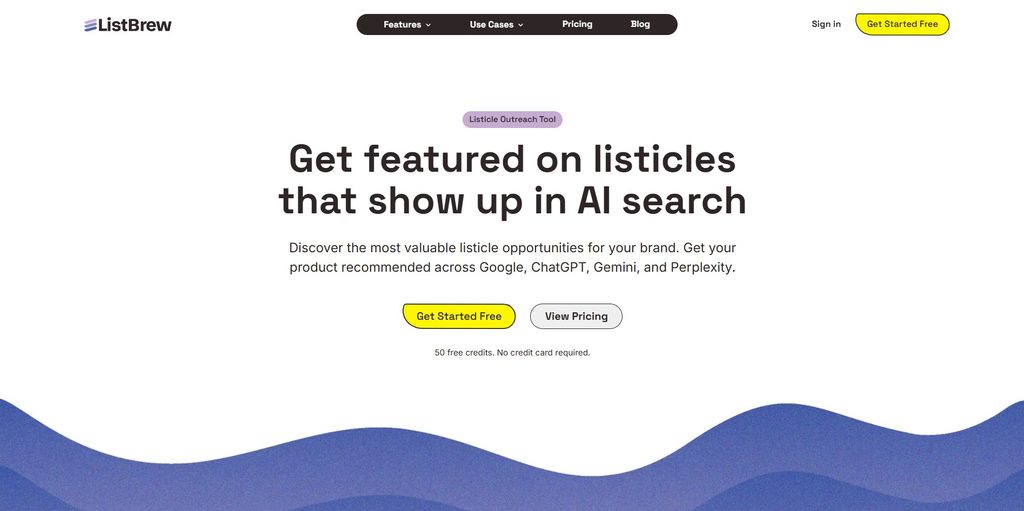
ListBrew is a specialized link building and AI citation prospecting platform designed to help brands find opportunities in listicles, comparison articles, buying guides, and other pages that already rank in Google or appear as sources in AI-generated answers. It identifies publications where competitors are mentioned but a target brand is missing, helping link builders prioritize outreach opportunities instead of manually searching SERPs and AI platforms.
Established: 2026
Founder Led: Yes
Leadership Experience: ListBrew was developed by the Position Digital team and is connected with agency founder Sean Begg Flint, drawing on experience in SEO, digital PR, and outreach campaigns.
Average Review Score: No substantial independent review profile yet
Starting Price: Free plan available; paid plans start at around $49/month
Notable Users: SaaS companies, SEO agencies, link builders, AI visibility teams, digital PR specialists, and brands targeting listicle placements
Approach to Link Building:
- Listicle opportunity discovery
- Competitor mention analysis
- Google SERP research
- Google AI Overview citation research
- ChatGPT citation research
- Gemini citation research
- Perplexity citation research
- AI visibility prospecting
- Competitor exclusion analysis
- Contact discovery
- Hunter.io contact enrichment
- Apollo contact enrichment
- Editor and content manager discovery
- Prospect list organization
- CSV exports
- AI-assisted outreach personalization
- Listicle placement outreach
- Multi-client prospecting
- Guest post prospect research
Summary of Online Reviews:
ListBrew is still relatively new, so there is limited independent customer review data available compared with established platforms such as Ahrefs, Semrush, or BuzzStream. Its strongest differentiator is its narrow focus on listicles and third-party pages that already influence both Google rankings and AI-generated recommendations. The platform can reduce the manual work involved in searching Google, checking competitor mentions, reviewing AI citations, and finding publisher contacts.
Best For:
ListBrew is best suited for SaaS companies, SEO agencies, affiliate-focused brands, and AI visibility teams that want to identify high-value listicle placements and competitor mention gaps without manually reviewing hundreds of search results and AI citations.
10. Linkody

Linkody is a backlink monitoring and management platform designed to help SEO professionals, agencies, and website owners track the links pointing to their websites and competitors. It automates routine backlink checking by monitoring whether links remain live, identifying new and lost backlinks, providing SEO metrics, and sending reports when backlink changes occur. This can replace much of the repetitive link-checking work traditionally assigned to VAs.
Established: 2012
Founder Led: Yes
Leadership Experience: Linkody was founded by François-Louis Mommens, a software engineer and entrepreneur with experience in search technology, software development, and digital businesses.
Average Review Score: Around 4.8/5 on Capterra
Starting Price: Around €13.90/month, with lower pricing available on annual plans
Notable Users: SEO agencies, website owners, freelance SEOs, link builders, consultants, and marketers managing multiple backlink profiles
Approach to Link Building:
- Automatic backlink monitoring
- New backlink discovery
- Lost backlink detection
- Link status monitoring
- Competitor backlink monitoring
- Referring domain analysis
- Link placement verification
- Dofollow and nofollow analysis
- Anchor text monitoring
- Domain Rating metrics
- Domain Authority metrics
- Spam Score monitoring
- Link quality analysis
- Toxic backlink identification
- Link disavow support
- Competitor link opportunity research
- Email backlink reports
- Historical backlink tracking
- Multi-client backlink monitoring
Summary of Online Reviews:
Linkody receives positive reviews for its ease of use, backlink monitoring, automated notifications, and value for money. Users particularly appreciate being able to monitor link placements without repeatedly checking publishers manually. Reviewers also highlight its usefulness for identifying lost backlinks and monitoring competitor links. One limitation mentioned by users is that its backlink database may sometimes show fewer links than larger platforms, although its primary strength is ongoing monitoring rather than having the largest backlink discovery database.
Best For:
Linkody is best suited for SEO agencies, freelance link builders, website owners, and in-house SEO teams that already acquire backlinks through other channels and want an affordable way to automate link verification, detect lost placements, monitor competitors, and replace manual backlink-checking spreadsheets.
How Link Building Tools Help SEO Teams
Link building tools help SEO teams reduce the amount of repetitive work involved in finding prospects, researching websites, discovering contact details, sending outreach emails and checking whether backlinks remain live. Instead of managing every step manually, teams can use software to organize and automate large parts of the process.
These tools are especially useful for agencies that manage several clients at the same time. A single campaign may involve hundreds or even thousands of potential websites, which can be difficult to manage through spreadsheets alone. Link building platforms can keep prospect data, contact details, outreach history and backlink status in one place.
They can also help improve productivity by reducing the need for separate VAs for different tasks. For example, one tool may handle competitor backlink research, another may find verified emails, and another may automate outreach and follow-ups. When combined correctly, these tools can create a much faster link building workflow.
The main ways link building tools can help include:
- Finding relevant backlink opportunities faster
- Analyzing competitor backlinks
- Identifying guest post and niche edit prospects
- Finding publisher and editor contact details
- Verifying email addresses
- Organizing prospects in a CRM
- Personalizing outreach messages
- Sending outreach campaigns at scale
- Automating follow-up emails
- Tracking publisher replies
- Monitoring new and lost backlinks
- Checking whether links remain dofollow
- Managing multiple client campaigns
- Reducing spreadsheet and data-entry work
- Creating campaign reports
Link building tools do not remove the need for human decision-making. SEO teams still need to check website quality, choose the right prospects, review outreach messages and build relationships with publishers. However, automation can remove much of the repetitive work and allow teams to focus more on strategy, negotiation and link quality.
How to Choose the Right Link Building Tool
The right link building tool depends on which part of your workflow takes the most time. Some teams need help with prospect research, while others need better contact discovery, outreach automation or backlink monitoring. Choosing the right platform starts with identifying the manual tasks your team or VAs currently handle.
If most of your time is spent finding websites and backlink opportunities, look for tools with strong competitor research, backlink gap analysis and prospect discovery features. Ahrefs and Semrush are useful for research-heavy workflows, while ListBrew is more focused on listicle and AI citation opportunities.
If contact research is the main bottleneck, tools such as Hunter.io and Skrapp.io can help find and verify professional email addresses. These platforms are useful when you already have a list of target websites but need to identify the right editor, content manager or decision-maker.
For teams that want to automate outreach and follow-ups, Pitchbox, Respona and BuzzStream are stronger options. They can help organize prospects, send personalized campaigns, manage replies and reduce repetitive communication work.
If you want to manage more of the link building process from one place, an all-in-one platform such as TaskGlaze may be a better fit. It combines backlink research, prospecting, contact discovery, outreach and monitoring in a single workflow.
Backlink monitoring should also be considered. Tools such as Linkody are useful for checking whether acquired links remain live, identifying lost backlinks and monitoring changes over time.
Before choosing a tool, consider:
- Which link building tasks take the most time
- How many campaigns you manage each month
- Whether you need research, outreach or monitoring
- How many team members will use the platform
- Whether the tool supports automation and follow-ups
- How accurate its contact and backlink data is
- Whether it integrates with your current workflow
- How much manual review is still required
- Pricing and limits
- Whether the platform can scale with your campaigns
For most teams, the best option is not always the tool with the most features. It is the one that removes the biggest bottleneck in the current link building workflow.
Benefits of Using Link Building Tools
Link building tools can make SEO campaigns faster, more organized and easier to scale. Instead of relying on manual research, spreadsheets and repetitive outreach tasks, teams can use software to manage large parts of the workflow more efficiently.
One of the biggest benefits is time savings. Tasks such as finding backlink opportunities, checking competitor links, searching for contact details, verifying emails and following up with publishers can take hours when done manually. Automation helps reduce this workload and allows SEO professionals to focus on strategy and relationship building.
Another benefit is better organization. Link building campaigns often involve hundreds of websites, contacts and conversations. A good tool can keep prospect lists, outreach history, link status and campaign notes in one place, reducing the risk of missed follow-ups or duplicate outreach.
The main benefits include:
- Faster backlink prospecting
- Less manual data entry
- Easier competitor backlink research
- More accurate contact discovery
- Better email verification
- Automated outreach and follow-ups
- Improved campaign organization
- Easier tracking of publisher replies
- Faster detection of lost backlinks
- Better reporting for clients
- Less dependence on spreadsheets
- More consistent outreach workflows
- Easier management of multiple campaigns
- Lower need for repetitive VA work
- Better scalability for agencies and SEO teams
Link building tools can also help improve consistency across campaigns. When processes are standardized, teams are less likely to miss prospects, forget follow-ups or lose track of acquired links.
The biggest advantage is scalability. A small SEO team can manage more campaigns without adding a new virtual assistant for every repetitive task. The tools handle much of the routine work, while the team focuses on link quality, publisher relationships and overall SEO strategy.
Red Flags to Watch for in Link Building Tools
Not every link building tool is a good fit for every team. Some platforms look powerful on the surface but may create extra work, poor outreach quality or unnecessary costs. Before choosing a tool, it is important to look for warning signs that could affect campaign performance.
One major red flag is poor data accuracy. If a tool regularly provides outdated contacts, invalid emails or irrelevant websites, your team may spend more time fixing the data than saving time. This can also hurt outreach performance and email deliverability.
Another warning sign is over-automation. Some platforms make it easy to send large numbers of emails, but highly automated campaigns can quickly become generic or spammy. Link building still requires relevant targeting, personalized messaging and human review.
Other red flags include:
- Outdated or inaccurate contact data
- Weak email verification
- Low-quality or irrelevant prospect suggestions
- Limited filtering options
- Generic AI-generated outreach
- Poor email deliverability controls
- No clear way to manage replies
- Weak CRM or campaign organization
- Limited backlink monitoring
- No alerts for lost links
- Hidden usage limits or expensive credit systems
- Pricing that increases quickly as campaigns scale
- Difficult onboarding or confusing workflows
- Weak customer support
- Limited integrations with existing SEO tools
- No export options or data ownership
- No free trial or clear product demo
Teams should also be cautious of tools that promise fully automated link building with little or no human involvement. Software can reduce repetitive work, but quality link acquisition still depends on good prospect selection, relevant outreach, relationship building and editorial judgment.
The best link building tools should reduce workload without reducing quality. If a platform creates more cleanup, sends low-quality outreach or makes campaign management harder, it may not be worth using.
How Much Do Link Building Tools Cost in 2026?
The cost of link building software varies widely depending on whether you need simple backlink monitoring, contact discovery, competitor research, outreach automation or a complete link building workflow. Entry-level tools can cost less than $20 per month, while advanced outreach platforms for agencies can cost several hundred dollars per month.
For smaller teams, affordable tools may be enough to handle one specific task. Linkody, for example, starts at €13.90 per month, while Hunter.io starts at $34 per month on annual billing and Skrapp.io starts at $39 per month when paid monthly.
All-in-one and specialist link building platforms usually cost more because they combine several functions. TaskGlaze starts at $39 per month, with annual billing reducing the effective cost to $31 per month. ListBrew starts at $49 per month, while BuzzStream’s core outreach platform starts around $49 per month.
Larger SEO platforms are more expensive but include many features beyond link building. Ahrefs offers limited Starter access for $29 per month, while its main Lite plan costs $129 per month. Semrush’s core SEO plan costs $139 per month when paid monthly.
Enterprise outreach platforms can be considerably more expensive. Pitchbox starts at $300 per month on monthly billing, or an effective $210 per month when billed annually. Higher plans increase limits for users, email accounts, campaigns, prospects and outreach volume.
Typical pricing in 2026 looks like this:
- Basic backlink monitoring: Around $10–$30 per month
- Email finding and verification: Around $30–$100+ per month
- Specialized link prospecting: Around $40–$100+ per month
- SEO and backlink research suites: Around $100–$250+ per month
- Outreach and link building CRM tools: Around $50–$300+ per month
- Agency and enterprise platforms: $300 to $1,000+ per month
Price should not be the only factor when choosing a tool. A $100 monthly platform may provide better value than several cheaper subscriptions if it replaces prospect research, contact discovery, outreach and monitoring tools at the same time.
Teams should also check usage limits carefully. Some platforms charge based on credits, contacts, backlink searches, email accounts or monthly outreach volume. These limits can make the real cost much higher as campaigns grow.
For agencies, the better question is often not “Which tool is cheapest?” but “How much manual VA work can this tool remove?” A more expensive platform can still save money if it reduces hours spent on prospecting, data entry, outreach, follow-ups and backlink monitoring.
The Future of Link Building Tools
The future of link building tools will be shaped by AI, better data, stronger automation and closer integration with search and AI visibility platforms. In 2026, many tools already help with prospecting, contact discovery, outreach and backlink monitoring, but the next generation will likely handle more of the workflow from one place.
AI will play a bigger role in prospect qualification and outreach personalization. Instead of sending the same template to hundreds of websites, tools will be able to analyze each prospect, understand the page context and generate more relevant outreach messages. This could make campaigns faster while still keeping a human review step.
Link building tools will also become more connected to AI search visibility. As brands compete to appear in Google AI Overviews, ChatGPT, Gemini, Perplexity and other answer engines, platforms may focus more on finding websites, listicles and publications that influence both traditional search rankings and AI-generated recommendations.
Another major change will be better workflow automation. Future platforms may combine backlink research, contact enrichment, outreach, negotiation, placement tracking and reporting in one system. This could reduce the need to use several separate tools for the same campaign.
We are also likely to see more emphasis on:
- AI-powered prospect qualification
- Smarter outreach personalization
- Automated publisher follow-ups
- AI-assisted negotiation
- Better email deliverability controls
- Real-time backlink monitoring
- AI citation and brand mention tracking
- Listicle and comparison-page prospecting
- Automatic detection of lost links
- Better spam and quality filtering
- More accurate contact databases
- Deeper CRM integrations
- Automated campaign reporting
- Multi-client agency dashboards
- Search and AI visibility reporting in one place
However, link building is unlikely to become completely automated. Human judgment will still be important for evaluating website quality, choosing the right opportunities, building publisher relationships and reviewing outreach before it is sent.
The most useful tools will be those that automate repetitive work without making campaigns look automated. For SEO agencies and in-house teams, the future is likely to be a combination of AI-powered software and human strategy rather than software replacing people completely.
Related Guides
- Top Link Building Tools to Use in 2026
- Best Tools for Competitor Backlink Analysis
- Best Link Building and Digital PR Outreach Platforms
- Top Pitchbox Alternatives for Link Building Teams
- Best All-In-One SEO Tools For Small Agencies
Frequently Asked Questions About Link Building Tools
What are link building tools?
Link building tools are software platforms that help SEO teams research backlink opportunities, find publisher contacts, manage outreach, monitor links and track campaign performance. Some tools focus on one part of the process, while others combine several link building tasks in one platform.
Can link building tools replace virtual assistants?
They can replace or reduce many repetitive VA tasks, such as prospect research, contact discovery, email verification, follow-ups, backlink checking and reporting. However, human input is still important for quality control, relationship building, negotiation and deciding which opportunities are worth pursuing.
What is the best link building tool in 2026?
The best option depends on your workflow. TaskGlaze is useful for teams that want a more centralized link building process, Pitchbox is strong for large-scale outreach, Ahrefs and Semrush are better for backlink research, Hunter.io and Skrapp.io focus on contact discovery, and Linkody is useful for backlink monitoring.
Which link building tool is best for outreach?
Pitchbox, Respona and BuzzStream are strong options for outreach-focused campaigns. They help teams organize prospects, personalize emails, manage follow-ups and track communication with publishers.
Which tool is best for finding backlink opportunities?
Ahrefs and Semrush are strong for competitor backlink research and backlink gap analysis. ListBrew is more specialized for finding listicle, comparison-page and AI citation opportunities.
Which link building tools are best for finding email addresses?
Hunter.io and Skrapp.io are among the most useful options for finding and verifying professional email addresses. They can help identify editors, content managers and other decision-makers without manually searching each website.
Can AI automate link building outreach?
AI can help with prospect research, personalization, email drafting, follow-ups and campaign organization. However, fully automated outreach can become generic or spammy if there is no human review. The best approach is to use AI for repetitive tasks while keeping people involved in targeting and relationship management.
Are free link building tools worth using?
Free plans can be useful for small campaigns, testing a platform or handling a limited number of prospects. However, larger campaigns usually require paid plans because free accounts often have limits on searches, contacts, credits, emails or tracked backlinks.
How much should I spend on link building software?
Small teams may spend around $30 to $100 per month, while agencies using multiple research and outreach platforms may spend several hundred dollars per month. The right budget depends on campaign size, prospect volume and how much manual work the software can replace.
Do link building tools guarantee backlinks?
No. These tools can make prospecting, outreach and monitoring easier, but they cannot guarantee that publishers will respond or add a link. Backlink success still depends on relevance, content quality, outreach messaging, relationships and the value offered to the publisher.
Are automated link building tools safe for SEO?
They can be safe when used to support legitimate research, outreach and monitoring. Problems usually arise when automation is used for spam, irrelevant mass outreach or low-quality link schemes. Teams should still follow Google’s spam policies and focus on earning relevant, editorially placed links.
Can one tool manage the entire link building process?
Some platforms can cover a large part of the workflow, but many teams still combine multiple tools. For example, they may use Ahrefs for backlink research, Hunter.io for contact discovery, BuzzStream for outreach and Linkody for monitoring. All-in-one platforms can reduce the number of tools required, but the best setup depends on the campaign.