Your press release has about three seconds in an editor’s inbox.
Three seconds. Before they hit delete or keep reading.
Most press releases die in those three seconds. Not because the news is bad. Because the writing is terrible. The headline is vague. The first sentence is stuffed with corporate language. The whole thing reads like a brochure instead of a news story.
Here is the truth nobody tells you. Journalists are not looking for reasons to cover you. They are looking for reasons to skip you. Your job is to give them no reason to skip.
This guide shows you exactly how to write a press release that makes editors stop, read, and actually want to run the story. We cover the format, the structure, the writing, the distribution, and the mistakes that kill coverage before it even starts.
What Is a Press Release?
A press release is a short, structured document that announces something newsworthy to journalists and media outlets. It gives reporters the who, what, when, where, and why of a story in a format they can act on fast.
Think of it as a pitch and a story rolled into one. It tells the journalist why the story matters. It gives them enough detail to write about it without starting from scratch.
Businesses use press releases to announce product launches, funding rounds, partnerships, awards, leadership changes, research findings, and major company milestones. When a press release lands in the right inbox at the right time with the right angle, it earns coverage that builds credibility, generates backlinks, and reaches audiences no ad budget can touch.
At Bluelinks Agency, press releases are a core part of the digital PR campaigns we run for clients. Done right, a single well-placed press release lands your story in dozens of publications and earns high-authority backlinks that move your search rankings for months.
When Should You Write a Press Release?
Not every update needs a press release. Journalists receive hundreds of pitches every day. Sending a press release about something that is not genuinely newsworthy wastes their time and damages the relationship you need for future coverage.
Write a press release when you have one of these:
A product launch or major update that solves a real problem for a real audience.
A funding round such as a seed investment, Series A, or significant capital raise.
A partnership or acquisition that changes how your business operates or who it serves.
Original research or survey data that reveals something surprising about your industry.
A significant award or recognition from a credible, independent third party.
A new executive hire that signals growth or a clear strategic shift.
A milestone that proves scale: one million customers, ten years in business, a landmark contract win.
If your news does not fit one of those categories honestly, it probably does not need a press release. It might need a blog post instead.
The Anatomy of a Press Release
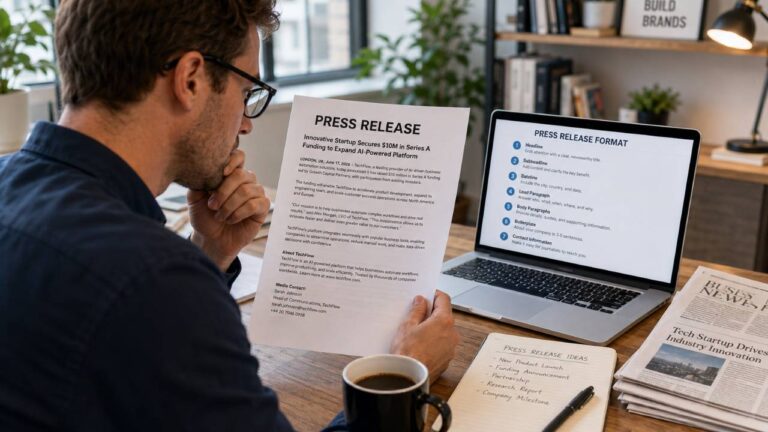
Before you write a single word, understand the structure. A professional press release has seven distinct parts. Each one serves a specific purpose and each one matters.
1. The Headline
The most important line you will write. It decides whether the journalist reads further or deletes the email. Keep it to one sentence. Write it in present tense. Make it specific and newsworthy. Use zero buzzwords.
2. The Subheadline
One supporting sentence that adds context to the headline. Not every press release needs one, but it helps when the headline alone does not paint the complete picture.
3. The Dateline
The city and date at the start of the first paragraph. Standard format: CITY, Country, Month Day, Year. Example: LONDON, UK, June 17, 2026.
4. The Lead Paragraph
The most critical paragraph in the body. It answers all five questions: who, what, when, where, and why. A journalist should read only the lead and understand the complete story. If they need to go further to understand what happened, your lead paragraph has failed.
5. The Body
Two to three paragraphs that expand on the lead. Include a quote from a company spokesperson or executive. Add supporting facts, data, or context that give the story more depth and make it easier for a journalist to report.
6. The Boilerplate
A short “About the Company” paragraph at the very end. Three to five sentences. It covers what your company does, who it serves, and where to learn more. Use the same boilerplate consistently across every press release you send.
7. Contact Information
The name, email address, phone number, and website of your media contact. Goes at the very end. Make it easy for journalists to reach a real person quickly.
How to Write Each Section
Let’s go section by section. Here is exactly how to do each one.
How to Write a Press Release Headline
Your headline needs to be clear, specific, and immediately newsworthy. It should read like a real news headline, not a marketing slogan.
Bad headline: Bluelinks Agency Announces Exciting New Partnership
Why it fails: “Exciting” is not a fact. “New” tells us nothing specific. The reader learns nothing about what actually happened.
Good headline: Bluelinks Agency Partners With LeadForge to Deliver Full-Funnel Digital PR for UK Startups
Why it works: Specific. Names both parties. States the outcome. The reader knows exactly what happened before they reach the body.
Four rules for every press release headline:
Write in present tense. Keep it under 12 words. Use real names and real outcomes. Cut every adjective that is not a measurable fact.
How to Write the Lead Paragraph
The lead is not a warm-up. It is the story. Put your most important information first.
Bad lead: Bluelinks Agency, a leading provider of digital PR and SEO services, is proud to announce today that the company has entered into a new partnership…
Why it fails: Buries the news. “Leading provider” is self-promotion, not a fact. “Proud to announce” wastes five words saying nothing. The reader has to wade through filler before they learn what happened.
Good lead: Bluelinks Agency today launched a new digital PR retainer for UK-based startups, combining media outreach, link-building, and search strategy into a single monthly package starting at £1,500.
Why it works: Who (Bluelinks Agency). What (new digital PR retainer). When (today). Where (UK). Why (combines three services into one package). All five Ws in two sentences.
How to Write the Body
The body gives journalists more to work with. Focus on three things: supporting facts, a strong quote, and brief context.
Supporting facts: Numbers, data, timelines, or outcomes that prove your headline is true. Specifics always beat generalities. “30 percent more clients” beats “significant growth.”
The quote: Get a quote from someone with a real name and a real title. The quote should say something a sentence of facts cannot. A great quote gives opinion, perspective, or insight. It does not repeat information you already stated.
Good quote: “Most UK startups pour budget into ads before they have any earned credibility online. We built this package to flip that order.” Said Fakhir Ali, Founder, Bluelinks Agency.
Bad quote: “We are thrilled to announce this exciting new offering and look forward to serving our valued clients.” This quote says nothing. Cut it entirely.
Context: One short paragraph explaining why this news matters right now. Is there a market trend behind it? A problem it solves? What changes for customers because of this?
How to Write the Boilerplate
Your boilerplate is your company’s permanent biography for the media. Write it once. Use it on every press release you send.
Three to five sentences. Cover what you do, who you serve, and where to learn more.
Example: Bluelinks Agency is a digital PR, SEO, and online reputation management agency serving businesses across the US, UK, UAE, and Pakistan. The agency helps brands build credibility, earn media coverage in authoritative publications, and improve search rankings through coordinated digital strategy. Founded by Fakhir Ali, Bluelinks Agency operates as part of Bluelinks Group Ltd, UK.
Press Release Template
Copy this, fill in the brackets, and you have a professional press release ready to send.
FOR IMMEDIATE RELEASE

[HEADLINE: One clear, specific, newsworthy sentence in present tense]

[SUBHEADLINE: One supporting sentence with additional context (optional)]

CITY, Country, Month Day, Year. [Company Name] today [announced / launched / partnered with] [what happened]. [One sentence explaining the outcome or significance]. [One sentence with a key detail: price, timeline, location, or target audience].

[Paragraph 2: Supporting facts and context. Two to three sentences. Use numbers and specifics wherever possible. Explain why this news matters right now and who it affects].

"[Quote from a named executive. Make it say something opinionated, insightful, or forward-looking. Not a restatement of the news]," said [Full Name], [Title], [Company Name].

[Paragraph 3: Additional background, customer impact, or next steps. One to three sentences. Keep it tight].

About [Company Name]
[Three to five sentence boilerplate describing what you do, who you serve, and where to learn more].

###

Media Contact:
[Full Name]
[Title]
[Email Address]
[Phone Number]
[Website URL]
The three hash symbols (###) at the end signal to journalists that the press release is complete.
What Makes a Journalist Open a Press Release?
The format gets your press release structured correctly. The writing gets it covered. Here is what separates press releases that earn media placements from ones that get deleted.
A genuine news angle. Ask yourself honestly: would a reader who has never heard of your company care about this? If the answer is no, the press release will not work no matter how well you write it. Fix the angle first.
A subject line that earns a click. Treat the email subject line exactly like you treat the headline. Be specific. Lead with the news. Strip out the superlatives. “Bluelinks Agency Launches UK Startup PR Package Starting at £1,500” beats “Exciting Announcement from Bluelinks Agency” every single time.
Personalization. Send the right press release to the right journalist. A tech reporter does not want your retail announcement. A local business editor does not need your international expansion story. Research who you are emailing and write the pitch to match their beat specifically.
Brevity. A press release should be 400 to 600 words. Journalists are busy. If you cannot tell the story clearly in 600 words, the story is not clear yet. Tighten it until it is.
A quote that actually says something. The quote is where most press releases waste their best opportunity. Give journalists a line they can pull directly into their story without editing.
Press Release Mistakes That Kill Your Coverage
These are the mistakes we see most often, even from experienced and well-resourced teams.
Writing it as a marketing document instead of a news story. A press release is not an advertisement. Remove phrases like “industry-leading,” “best-in-class,” “we are excited to announce,” and “proud to share.” Replace every one of them with a verifiable fact.
Burying the news. The most important information belongs in the first sentence of the body. Not the second paragraph. Not after two sentences of company background. The very first sentence.
Including a quote that says nothing. A quote from your CEO saying “we are thrilled” is worse than no quote at all. If the quote does not add genuine insight or perspective, delete it.
Sending it to the wrong journalists. Spray-and-pray distribution wastes time and burns relationships you need for future pitches. Build a targeted media list of journalists who genuinely cover your space and send to them specifically.
Not following up. Most coverage comes from the follow-up, not the initial send. Wait five to seven business days and send one short, polite follow-up email. One follow-up only. Never more.
Skipping the distribution strategy. Writing a great press release and emailing it to five contacts is not a strategy. You need a combination of targeted outreach and wire distribution to generate reach and backlinks at scale.
How to Distribute Your Press Release
Writing the press release is half the work. Distribution determines whether it earns coverage.
Targeted outreach. Build a media list of journalists who cover your industry, your region, or your specific topic. Personalize every email you send. Lead with why this story fits their beat and their audience specifically.
Wire distribution. Services like EIN Presswire, AccessWire, and PR Newswire push your press release to hundreds of news outlets simultaneously. Wire distribution generates immediate broad coverage and creates backlinks from news aggregators and regional outlets. For clients targeting financial and business news specifically, Barchart.com is one of the strongest options available.
Follow-up outreach. Five to seven business days after the initial send, follow up with your targeted list. Keep it brief: one sentence referencing the original press release and one sentence offering to answer questions or arrange an interview.
Track your results. Monitor which outlets picked up the story. Track the backlinks generated using Ahrefs or Semrush. Record which journalists responded positively and nurture those relationships for your next campaign. Each placement makes the next one more achievable.
Frequently Asked Questions About Press Releases
How long should a press release be?
A press release should be between 400 and 600 words. One page is ideal. Two pages is the absolute maximum. The best press releases say everything they need to say in a tight, well-structured format because journalists do not have time to read long documents.
What is the correct format for a press release?
A press release follows this order: headline, optional subheadline, dateline, lead paragraph answering who, what, when, where, and why, two to three body paragraphs with a quote, boilerplate, and media contact information. Always end with three hash symbols to signal the end of the release.
How do I write a press release headline?
Write it in present tense. Keep it under 12 words. Be specific: name the company, name what happened, and name the outcome. Cut every adjective that is not a measurable, verifiable fact.
Do press releases still work in 2026?
Yes, but only when they announce genuinely newsworthy stories and reach the right journalists through targeted distribution. Press releases that cover real news sent to relevant reporters still earn media coverage, generate backlinks, and drive qualified traffic. Generic announcements sent to mass lists do not work and never did.
What is a boilerplate in a press release?
A boilerplate is a standardized short paragraph at the end of a press release that describes your company. It covers what you do, who you serve, and how to find out more. Use the same boilerplate across every press release for consistency and brand recognition.
Should I send a press release or a pitch email?
Both. Send a concise pitch email that explains why the story is relevant to that specific journalist, then include or attach the full press release below the pitch. The pitch earns their attention. The press release gives them everything they need to report the story accurately.
How much does press release distribution cost?
Free wire services like EIN Presswire offer basic distribution at low or no cost. Premium services like PR Newswire or Business Wire range from $400 to $2,000 per release depending on distribution reach and audience targeting. At Bluelinks Agency, we handle end-to-end press release writing and distribution as part of our digital PR packages.
Write It Like News. Distribute It Like Strategy.
A press release is one of the most underused tools in digital marketing. Most businesses write them wrong, send them to the wrong people, and then wonder why nobody picks up the story.
Write it the right way and the results compound. Journalists read it. Publications cover it. Backlinks come in. Search rankings improve. Your brand earns credibility that no amount of ad spend can replicate.
At Bluelinks Agency, we have written and distributed press releases for clients across healthcare, law, technology, and financial services. We have placed stories in Yahoo Finance, Business Insider, and major industry publications across three continents. Every press release we write follows the same principle: write it like a news story, distribute it like a strategy, and measure every result.
If you want us to write and distribute your next press release, we are ready.